
ONGC was the top gainer in the Sensex pack, rallying around 5 per cent, followed by NTPC, Reliance Industries, IndusInd Bank, Axis Bank and PowerGrid. NSE Nifty rose 115.35 points to reclaim 15,000 level.

People are availing far more of certain kinds of unsecured loans than was the case before the pandemic. Bank lending for buying consumer durables and funding of credit cards and other personal loans have risen by Rs 6.9 trillion between August 2019 and August 2023, shows a Business Standard analysis of data from the Reserve Bank of India (RBI). These loans are typically unsecured, which means they are provided without collateral.

WhatsApp's advantage is that it is the first app millions of Indian check first thing in the morning and innumerable times during the day and night.

The third-quarter financials didn't excite market watchers. But equity investors can still make money if they invest in the right stocks.

Private life insurers experienced reasonable growth in the July-September quarter (second quarter, or Q2) of 2023-24 (FY24), and the October data is also encouraging. The individual weighted received premium (WRP) for private players grew by 19.8 per cent year-on-year (Y-o-Y) in October. However, Life Insurance Corporation (LIC) of India had slower growth, pulling the industry growth rate down to 13 per cent Y-o-Y.

Benchmark indices ended on a firm note on Friday, extending their previous day's gain, amid continuous foreign fund inflows and a positive trend in the global markets. The 30-share BSE Sensex climbed 104.92 points or 0.18 per cent to settle at 59,793.14. During the day, it jumped 431.58 points or 0.72 per cent to 60,119.80.

Bajaj Finance was the top loser in the Sensex pack, shedding around 3 per cent, followed by Bajaj Finserv, Reliance Industries, M&M, Nestle India and SBI. On the other hand, Axis Bank, Tech Mahindra, PowerGrid and Maruti were among the gainers.
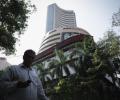
The Sensex came under fag-end selling pressure to close in the red for the sixth straight session on Friday as risk-off sentiment prevailed amid unabated selling by foreign institutional investors and concerns over inflation. The 30-share BSE benchmark pared all intra-day gains and declined 136.69 points or 0.26 per cent to end at 52,793.62. During the day, it had rallied 855.4 points or 1.61 per cent to 53,785.71. On similar lines, the broader NSE Nifty dipped 25.85 points or 0.16 per cent to settle at 15,782.15.

Global funds, according to Christopher Wood, global head of equity strategy at Jefferies, are now beginning to pay more attention to India with the market now offering 30 companies with a market capitalisation over $25 billion.

IndusInd Bank was the top gainer in the Sensex pack, rising nearly 6 per cent, followed by Axis Bank, SBI, Maruti, Tech Mahindra and Reliance Industries. NSE Nifty surged 183.70 points to close at 17,166.90.

Billionaire Mukesh Ambani's Reliance Industries Ltd is the most valuable private company in the country, as per Hurun India's 2022 Burgundy Private Hurun India 500 list. The list, which was released on Tuesday, stated that with a value of Rs 16.4 lakh crore, Reliance is India's most valuable company, followed by Tata Consultancy Services (TCS) with Rs 11.8 lakh crore and HDFC Bank with Rs 9.4 lakh crore. Reliance is also the highest taxpayer with a payout of Rs 16,297 crore and the most profitable company with a bottomline of Rs 67,845 crore in 2022-23.

Equity benchmark Sensex rallied 936 points on Monday, helped by heavy buying in banking and IT counters along with decline in oil prices amid hopes of headway in renewed diplomatic talks between Russia and Ukraine. A fresh round of talks is expected on Monday between Ukrainian and Russian officials. Rising for the fifth straight session, the BSE Sensex jumped 935.72 points or 1.68 per cent to settle at 56,486.02.

It won't be easy for the banking sector to better its performance every quarter, predicts Tamal Bandyopadhyay.

Billionaire Mukesh Ambani's Reliance Industries Ltd climbed eight spots to the 45th rank, the highest for an Indian company on Forbes' latest Global 2000 list of public companies worldwide.
At a time when banks are engaged in a fierce battle to gain market share in the credit card segment, Citibank India has been losing its share, both in terms of outstanding cards and spends in the last few years. Still, average spends on Citi cards are higher than any other Indian bank. Last year, the global banking behemoth announced exit from its consumer banking franchises in 13 markets across Europe, Middle East and Asia, including India, citing lack of scale.

Investors may have to wait a little longer for Unified Payments Interface (UPI)-based block mechanism in the secondary market even as the market regulator has set the effective launch date as January 1, 2024. Several brokerage firms said they may take a few months more to implement it. Investors will be able to register for this facility only if the stock broker has opted for the UPI block facility.

Credit card spending has hit a record high of Rs 1.4 lakh crore in May, the latest data from Reserver Bank of India showed. The total spending or outstanding dues on credit cards, which remained rang-bound throughout the year in the previous fiscal, have been rising by 5 per cent month on month this year. Similarly, the number of cards in use has also jumped by more than 5 million since January and crossed 87.4 million in the reporting month, making this also an all-time high in May, according to the RBI data.
Equity markets halted their two-day rally on Friday, with the Sensex tumbling 714.53 points amid weak global equities and selling in index majors Infosys, ICICI Bank, HDFC Bank and Reliance Industries. Continuous foreign fund outflows also dented sentiments. The BSE benchmark Sensex tanked 714.53 points or 1.23 per cent to settle at 57,197.15. During the day, it plummeted 776.96 points or 1.34 per cent to 57,134.72. The NSE Nifty also declined 220.65 points or 1.27 per cent to 17,171.95.

Among the prominent gainers on the Sensex chart were Bajaj Finance, Bajaj FinServ, ICICI Bank, Axis bank, Tata Steel, IndusInd Bank and HDFC Bank -- rising as much as 3.50 per cent. NSE Nifty soared 271.65 points to settle at 17,625.70.

JM Financial, Axis Bank, and Bank of America have been roped in as the bankers to run the mandate, say sources.

L&T was the top loser in the Sensex pack, shedding around 2 per cent, followed by Reliance Industries, Bajaj Finserv, IndusInd Bank, SBI, Maruti, Axis Bank and Bajaj Auto.

ICICI Bank was the top gainer in the Sensex pack, surging nearly 3 per cent, followed by HDFC, Axis Bank, Sun Pharma, NTPC and M&M. NSE Nifty surged 119.75 points to 15,812.35.

Bajaj Auto was the top loser in the Sensex pack, shedding around 2 per cent, followed by TCS, HDFC Bank, Axis Bank, Reliance Industries and Tech Mahindra. On the other hand, Tata Steel, Bajaj Finserv, Bharti Airtel and NTPC were among the gainers. NSE Nifty dropped 38.10 points to close at 15,689.80.
Weakness in HDFC Bank's net interest margin (NIM) might have bottomed out in the July-September quarter (Q2-FY24), analysts said on Tuesday, as most of the merger-related one-time adjustments have been done. The bank, they believe, should be able to grow from here on, allowing the stock to reverse its underperformance. "The weak NIM print was not unexpected given the merger and regulatory impact caused by the incremental cash reserve ratio (ICRR; 5-10 bps for the quarter).

Investors became richer by over Rs 2.27 lakh crore on Monday as equities rebounded, with the BSE Sensex rallying over 1 per cent amid continuous foreign fund inflows and upbeat global markets. The 30-share BSE Sensex jumped 709.96 points or 1.16 per cent to settle at 61,764.25. During the day, it zoomed 799.9 points or 1.31 per cent to 61,854.19. Following the rally, the market capitalisation of BSE-listed firms jumped by Rs 2,27,794.46 crore to Rs 2,76,06,443.06 crore.

Titan was the top gainer in the Sensex pack, soaring nearly 7 per cent, followed by ONGC, L&T, Kotak Bank, Axis Bank, Bajaj Finance and HDFC Bank. NSE Nifty soared 114.15 points to end at its lifetime peak of 15,690.35.

The Reserve Bank of India's (RBI's) move to ban Mastercard from issuing new cards for not complying with the local data storage guidelines may hit five private banks, a non-bank lender, and a major card-issuing company. The impact is expected to be felt for a few months as these players transition to other card networks. According to Nomura Research, RBL Bank, YES Bank, and Bajaj Finserv are the ones most impacted by the ban as all their credit card schemes are allied to Mastercard. Among others, IndusInd Bank, Axis Bank and ICICI Bank have 35-40 per cent of their credit card schemes tied to Mastercard, the report said.

But what do banks gain by opening their apps for all? The answer -- rival bank's customers under their fold.

IndusInd Bank was the top loser in the Sensex pack, tanking over 8 per cent, followed by Bajaj Finance, SBI, ONGC, Titan, M&M, Bajaj Finserv, ICICI Bank and Axis Bank. NSE Nifty plunged 524.05 points to finish at 14,310.80.

Investors' wealth climbed Rs 3.20 lakh crore as markets staged a smart comeback on Wednesday after falling in the last eight trading sessions. The BSE Sensex rallied 448.96 points or 0.76 per cent to settle at 59,411.08. During the day, it jumped 513.33 points or 0.87 per cent to 59,475.45.

To educate customers on the modus operandi of financial fraudsters and share inputs on safe banking habits, banks are now coming up with awareness campaigns aimed at preventing customers from falling into the trap of fraudsters.

Between March 2022 and September 2023, HDFC Bank added 56,310 employees.

IndusInd Bank was the top loser in the Sensex pack, shedding around 4 per cent, followed by PowerGrid, ICICI Bank, HDFC Bank, Axis Bank and Bajaj Finance. NSE Nifty dipped 7.60 points to 14,736.40.
Spending through the credit card in March 2022 jumped 48 per cent year-on-year to top Rs 1 trillion -- five months after it had hit the same figure for the first time in October 2021, buoyed by festive season expenditure. The jump has been driven by the pickup in consumption as the pandemic recedes. Expenditure in March, at Rs 1.07 trillion, was up 24.5 per cent over February, the data put out by the Reserve Bank of India (RBI) showed.

Benchmark BSE Sensex rose by 156 points while the Nifty closed above the 17,300 level on Thursday after gains in metal, IT and capital goods shares amid foreign capital inflows. The 30-share BSE benchmark gained 156.63 points or 0.27 per cent to settle at 58,222.10. During the day, it jumped 513.29 points or 0.88 per cent to 58,578.76.
Equity investors became richer by Rs 5.66 lakh crore as markets bounced back sharply on Tuesday following a recovery in global equities. The 30-share BSE Sensex jumped 1,276.66 points or 2.25 per cent to settle at 58,065.47 points. During the day, it zoomed 1,311.13 points or 2.30 per cent to 58,099.94 points. The market capitalisation of BSE-listed firms climbed Rs 566,318.84 crore to Rs 273,92,739.78 crore.

Benchmark stock indices rebounded around 1 per cent on Thursday following value buying in banking, IT and auto stocks after two days of losses and a largely positive trend in global markets. The 30-share BSE Sensex climbed 659.31 points or 1.12 per cent to settle at 59,688.22. During the day, it jumped 683.05 points or 1.15 per cent to 59,711.96. The broader NSE Nifty rose by 174.35 points or 0.99 per cent to close at 17,798.75.

In a daring robbery at an ATM kiosk on Chakan-Alandi Road near Pune in the wee hours of Sunday morning, burglars stole Rs 16 lakh (Rs 1.6 million) by triggering a low intensity blast at the cash dispenser.

There has been a sharp recovery in the headline corporate earnings in the April-June 2023 quarter (Q1FY24), after a dismal showing by early bird companies. The combined net profit of the 983 listed companies that have declared their quarterly results, so far, was up 64.7 per cent year-on-year to record a high of Rs 2.68 trillion in the first quarter, but growth in earnings remained lopsided because most of the incremental gains came from a handful of companies. Moreover, the quarterly numbers showed a continued slowdown in revenue growth.

The drop in net interest margin will separate the men from the boys, explains Tamal Bandyopadhyay.
